


My Funded Futures coupon code: BRIDGE for 50% off. Verified on 13 October 2026 and tested every day: one code goes in the box at checkout, and BRIDGE is the one we test. See the My Funded Futures coupon code and every price
Quick answer: The My Funded Futures coupon code is BRIDGE: 50% off every MFFU plan and account size (Rapid, Rapid EOD, Builder, Pro), tested at checkout on 13 October 2026. My Funded Futures sells four plans. Rapid and Rapid EOD pay daily at a 90/10 split, Builder is the cheapest way in at 80/20, and Pro has no daily loss limit with payouts every 14 days at 80/20. None of them charge an activation fee. With code BRIDGE, every plan and every size was 50% off when I tested all 13 combinations at MFFU's checkout on 13 October 2026, so prices start at $52.50. The code's live status is on our My Funded Futures coupon code page.
Every rule in this guide comes from MFFU's own plan pages and our verified record of the firm. Every price comes from MFFU's checkout. I have written it the way I would explain it to a friend who is about to buy their first futures evaluation: plan by plan, then side by side, then how to pick a size.
MFFU Plans at a Glance
Before the details, here is the short version of all four plans on a $50K account, the size most traders start with.
| Rapid | Rapid EOD | Builder | Pro | |
|---|---|---|---|---|
| List price / with BRIDGE | $209 / $104.50 | $225 / $112.50 | $153 / $76.50 | $265 / $132.50 |
| Profit target | $3,000 | $3,000 | $3,000 | $3,000 |
| Max loss | $2,000 | $2,000 | $2,000 | $2,000 |
| Funded drawdown | Intraday trailing, locks at +$100 | End-of-day | End-of-day trailing | End-of-day |
| Daily loss limit | None | None | $1,000 soft pause | None |
| Minimum days | 2 | 4 | 1 | 2 |
| Payouts | Daily, $500 minimum | Daily, $500 minimum | After 2 qualifying days per cycle | 14 days from first trade, $1,000 minimum |
| Split | 90/10 | 90/10 | 80/20 | 80/20 |
If you only have a minute, this is how I would choose:
- You want money out fast: Rapid or Rapid EOD, with daily payouts at 90/10.
- You hold winners and do not want the floor to follow your open profit: Rapid EOD or Pro.
- You want the lowest price to start: Builder, $52.50 for $25K with BRIDGE.
- You trade big days and dislike daily limits: Pro.
How many plans does My Funded Futures have?
Four standard plans: Rapid, Rapid EOD, Builder and Pro. Rapid and Builder come in $25K, $50K, $100K and $150K. Rapid EOD comes in $25K and $50K. Pro comes in $50K, $100K and $150K. That makes 13 plan and size combinations, and MFFU also sells a couple of add-on versions, such as a Builder 50K with a reduced max loss and a Pro 50K one-day option.
Do any MFFU plans have an activation fee?
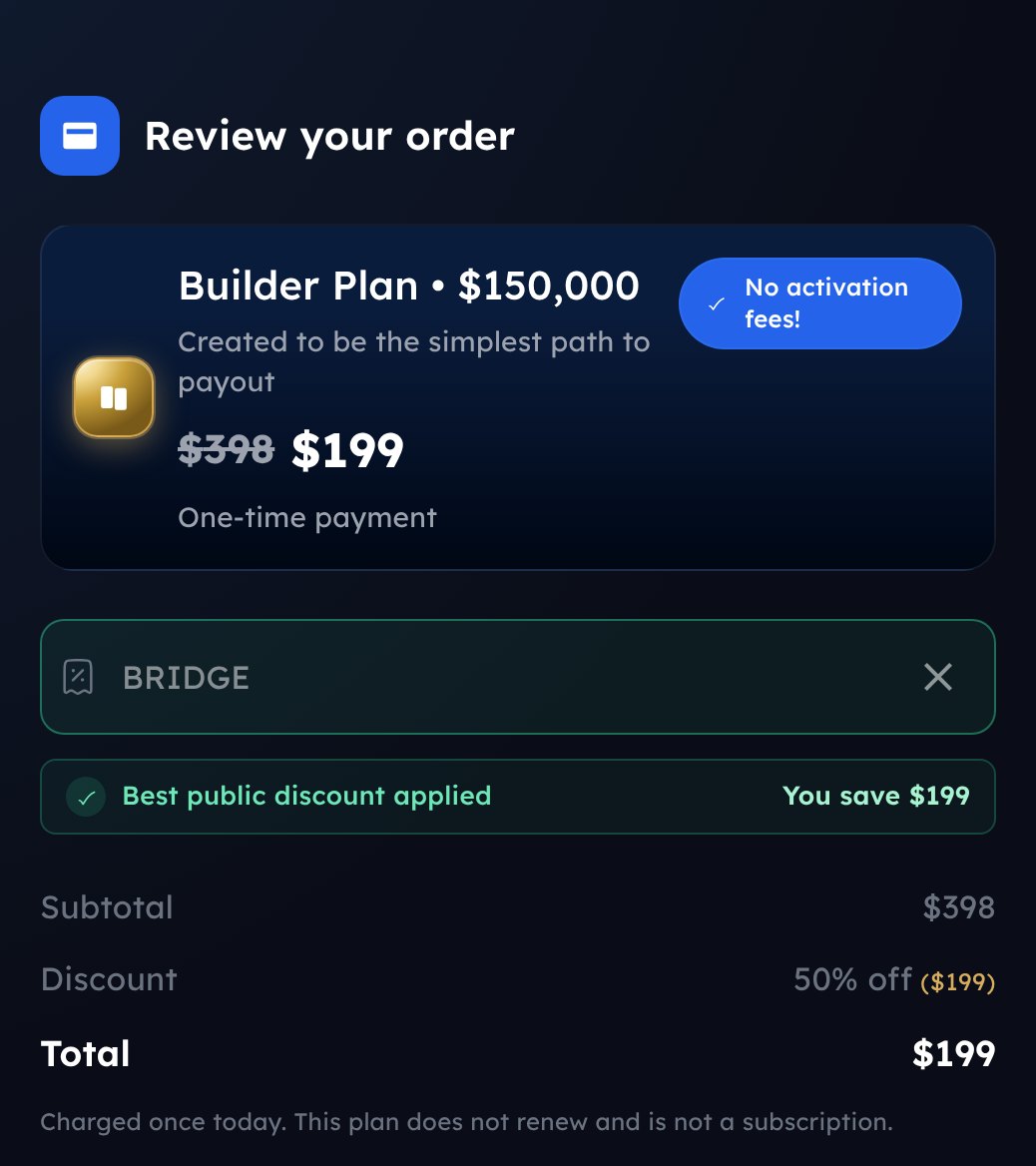
No. MFFU's checkout says "No activation fees!" and each plan is a one-time payment. So the price you pay at checkout is the whole cost of the evaluation. When you compare futures firms, that is worth remembering, because a fee after passing can add a lot to the real cost elsewhere.
Does the BRIDGE price apply to every plan?
Yes. On 13 October 2026 I tested BRIDGE on all 13 combinations and every one came out at half the list price. The checkout showed "Best public discount applied". BRIDGE gives MFFU's best public discount at the time you buy, and MFFU's site also shows "New to MFFU? Get 50% off your first eval" and "40% off any plan", so a returning trader may see MFFU's current returning offer. The full price list is in our MFFU coupon code guide.
My experience: the profit target and max loss are the same on all four $50K plans. That surprised me at first. It means the real choice is not how hard the target is, but how the drawdown moves and how fast you get paid.
MFFU Rapid: Daily Payouts, Intraday Funded Drawdown
Rapid is MFFU's plan for traders who want money out quickly. Once funded, you can request payouts daily, and you keep 90% of the profit.
| Account | Target | Max loss | Buffer before payouts | Contracts (evaluation) | Price / with BRIDGE |
|---|---|---|---|---|---|
| $25K | $1,500 | $1,000 | $1,100 | 3 minis / 30 micros | $145 / $72.50 |
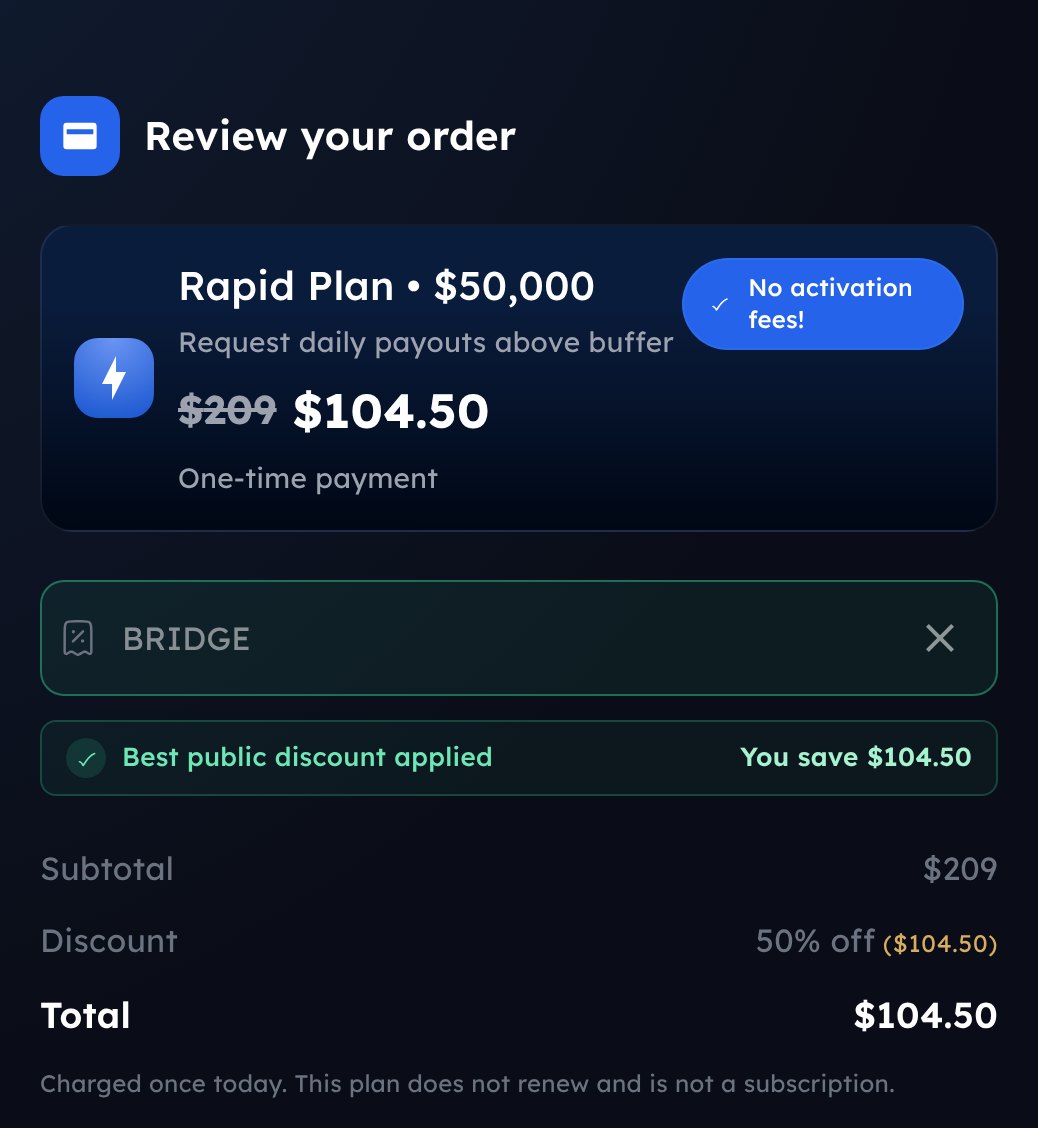
| $50K | $3,000 | $2,000 | $2,100 | 5 minis / 50 micros | $209 / $104.50 |
| $100K | $6,000 | $3,000 | $3,100 | 8 minis / 80 micros | $356 / $178 |
| $150K | $9,000 | $4,500 | $4,600 | 10 minis / 100 micros | $463 / $231.50 |
Contract limits are the evaluation maximums from our record; funded and live limits can differ.
BRIDGE verified on 13 October 2026 at MFFU's checkout:
How does the Rapid drawdown work?
In the evaluation, Rapid uses an end-of-day drawdown. Once you are funded, it changes: the max loss trails your balance intraday, which means it can move up during the day as your open profit grows. It keeps trailing until it locks at $100 above your starting balance, and then it stops moving.
In practice, the first part of a funded Rapid account is the tightest. Once the floor locks, you have a fixed line to trade above.
The buffer in the table is the profit you need above your starting balance before you can take money out: $1,100 on the $25K, $2,100 on the $50K, $3,100 on the $100K and $4,600 on the $150K. It is $100 more than the max loss, which matches the point where the funded drawdown locks. Once you are past it, payouts can be requested daily, with a $500 minimum. So the plan rewards you for building a small cushion first, and then lets you withdraw often.
Does MFFU Rapid have a consistency rule?
Yes, in the evaluation only. Rapid has a 50% consistency rule while you are passing, so one day cannot make up more than half of your profit. Once funded, that rule does not apply to the Rapid account.
Can I trade news on MFFU Rapid?
Our record shows Tier 1 news trading is allowed in the Rapid evaluation and not allowed once you are funded. If your strategy depends on big releases such as NFP or CPI, plan for that change before you pass. Weekend holding is not allowed.
My experience: Rapid is the plan I would pick if quick payouts matter most. I would just trade the first funded days smaller, until the drawdown locks at +$100.
MFFU Rapid EOD: Daily Payouts, End-of-Day Drawdown All the Way
Rapid EOD keeps the daily payouts and 90/10 split of Rapid, but the drawdown stays end-of-day even once you are funded. Your floor never follows your open profit during the day.
| Account | Target | Max loss (end-of-day) | Buffer | Price / with BRIDGE |
|---|---|---|---|---|
| $25K | $1,500 | $1,000 | $1,100 | $145 / $72.50 |
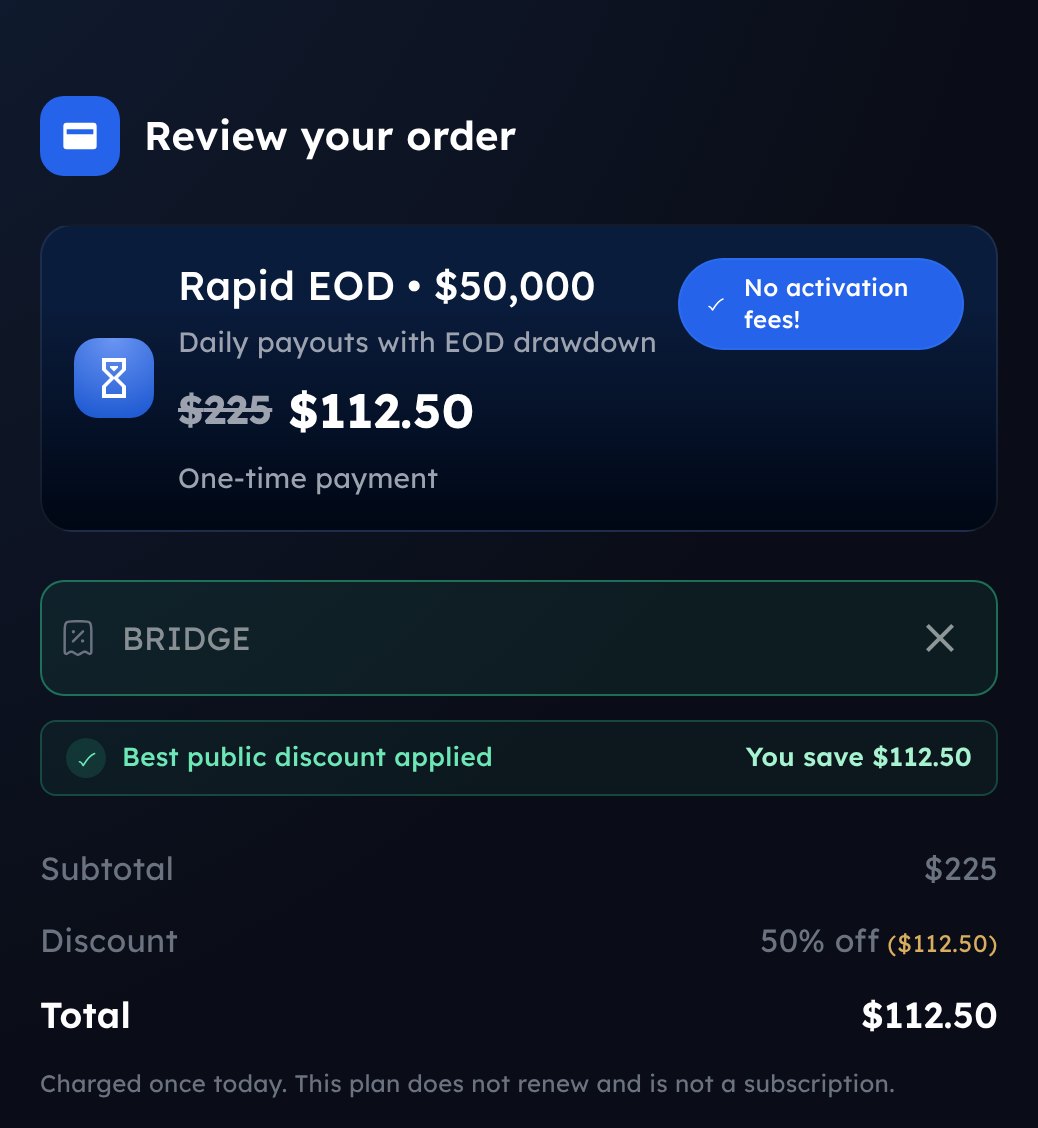
| $50K | $3,000 | $2,000 | $2,100 | $225 / $112.50 |
The $50K Rapid EOD evaluation allows up to 3 minis or 30 micros in our record.
What is the difference between Rapid and Rapid EOD?
Both pay daily at 90/10. The difference is the funded drawdown. On Rapid it trails intraday until it locks at +$100. On Rapid EOD it is only measured at the end of the day, so a trade that goes up and comes back during the day does not drag your floor up with it.
Rapid EOD also asks for 4 minimum trading days in the evaluation instead of 2, and the $50K costs a little more: $112.50 with BRIDGE instead of $104.50.
Does Rapid EOD have a consistency rule?
Yes, a 30% consistency rule in the evaluation, which is stricter than Rapid's 50%. It means no single day can be more than 30% of your total profit while you are passing. Once funded, there is no consistency rule on Rapid EOD.
Who should choose Rapid EOD?
Traders who let winners run. If you often hold a trade that is up a few hundred dollars and give some of it back before closing, an intraday trailing floor can catch you. The end-of-day floor gives you room for that. It also suits traders who are patient enough to spread profit over at least 4 days.
My experience: for most swing-style day traders I talk to, Rapid EOD is the most comfortable of the fast-payout plans. The extra $8 on the $50K is a small price for a floor that does not chase you.
MFFU Builder: The Cheapest Start
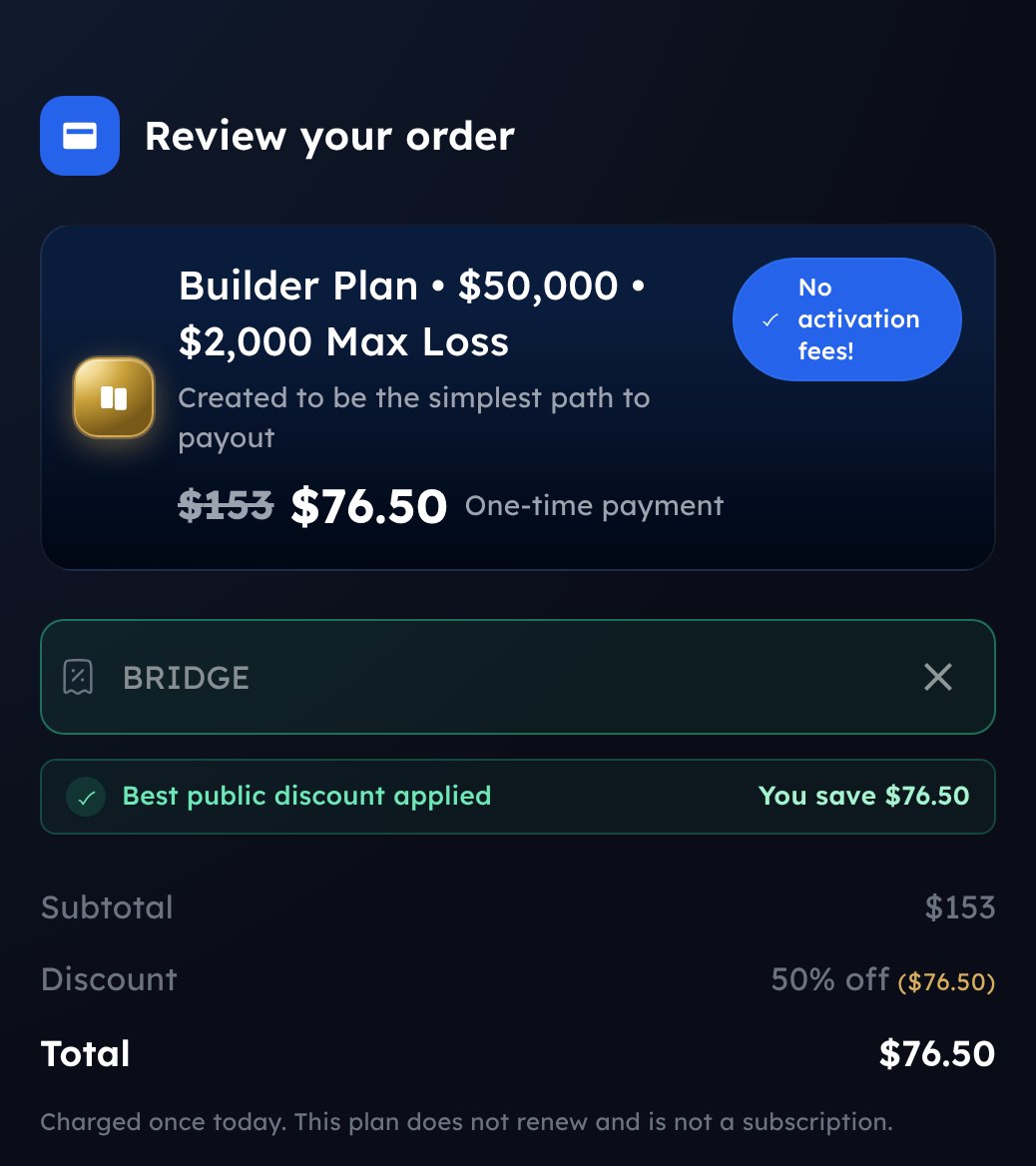
Builder is the lowest-priced way into My Funded Futures. With BRIDGE, a $25K Builder costs $52.50 and a $50K costs $76.50.
| Account | Target | Max loss (end-of-day trailing) | Daily loss (soft pause) | Price / with BRIDGE |
|---|---|---|---|---|
| $25K | $1,500 | $1,000 | $600 | $105 / $52.50 |
| $50K | $3,000 | $2,000 ($1,500 with add-on) | $1,000 | $153 / $76.50 |
| $100K | $6,000 | $3,000 | $1,750 | $282 / $141 |
| $150K | $9,000 | $4,500 | $2,500 | $398 / $199 |
In our record the $25K Builder evaluation allows up to 2 minis or 20 micros and the $50K up to 4 minis or 40 micros.
What is the Builder soft pause daily loss?
Builder has a daily loss limit, but it is a soft pause. If you hit it, you are stopped for the rest of the day, and the account is not failed. You come back the next session and carry on. Think of it as a seatbelt: it stops one bad day from becoming a lost account.
How do Builder payouts work?
Builder has no consistency rule in the evaluation and only 1 minimum day. Once funded, there is a 50% consistency rule on payouts, and you need 2 qualifying days in each payout cycle before you can request one. The split is 80/20. Overnight holding is not allowed on Builder, and weekend holding is not allowed either.
What is the Builder 50K reduced max loss add-on?
MFFU also sells a Builder 50K version with a $1,500 max loss instead of $2,000. It is a separate option at checkout, so check its price and rules there before you choose it. For most traders, the standard $2,000 max loss gives more room for the same target.
My experience: if you are new to futures, Builder is where I would start. It is the cheapest plan, it has the only daily limit that protects you without failing you, and you can pass in a single day if the market gives it to you.
MFFU Pro: No Daily Loss Limit, Bigger Payouts
Pro is the plan for traders who want fewer rules during the day and bigger payouts. There is no daily loss limit, and payouts come every 14 days.
| Account | Target | Max loss (end-of-day) | Buffer | Contracts (evaluation) | Price / with BRIDGE |
|---|---|---|---|---|---|
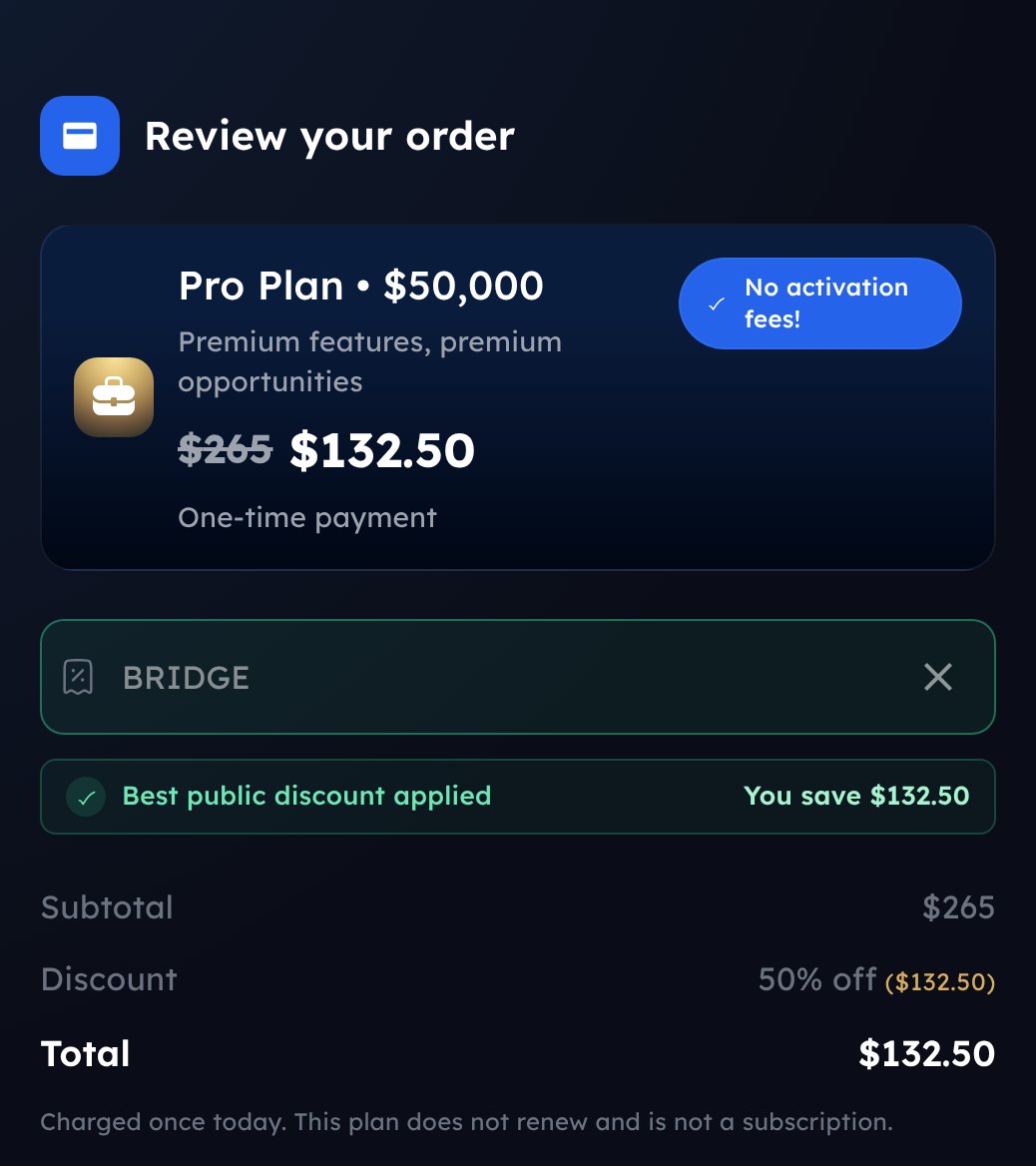
| $50K | $3,000 | $2,000 | $2,100 | 3 minis / 30 micros | $265 / $132.50 |
| $100K | $6,000 | $3,000 | $3,100 | 6 minis / 60 micros | $401 / $200.50 |
| $150K | $9,000 | $4,500 | $4,600 | 9 minis / 90 micros | $557 / $278.50 |
Does MFFU Pro have a daily loss limit?
No. Pro has no daily loss limit. The only line you must respect is the end-of-day max loss: $2,000 on the $50K, $3,000 on the $100K and $4,500 on the $150K. That gives you freedom, and it also means you have to set your own daily stop.
How often does MFFU Pro pay out?
Payouts come 14 days from your first trade, once you have cleared the buffer, with a $1,000 minimum payout. Pro allows up to $100,000 in sim payouts per user, and after 3 consecutive payouts there is a move to a live account. The split is 80/20. Pro has a 50% consistency rule in the evaluation only.
What is the Pro 50K one-day add-on?
MFFU sells a Pro 50K version with a one-day option. It is a separate item at checkout, so read its rules and price there. The standard Pro asks for 2 minimum days in the evaluation.
My experience: Pro fits traders who already know their daily risk and do not want a firm to stop them mid-session. If you still struggle to stop after a bad morning, I would pick Builder first.
MFFU Drawdown, Targets and Splits Side by Side
Now the four plans next to each other on the points that matter most once you are trading.
| Rapid | Rapid EOD | Builder | Pro | |
|---|---|---|---|---|
| Evaluation drawdown | End-of-day | End-of-day | End-of-day trailing | End-of-day |
| Funded drawdown | Intraday trailing, locks at +$100 | End-of-day | End-of-day trailing | End-of-day |
| Consistency (evaluation) | 50% | 30% | None | 50% |
| Consistency (funded) | None | None | 50% on payouts | None |
| Daily loss limit | None | None | Soft pause | None |
| Payout timing | Daily | Daily | After 2 qualifying days per cycle | Every 14 days |
| Split | 90/10 | 90/10 | 80/20 | 80/20 |
Are the MFFU profit targets the same on every plan?
Yes, for the same size. Every plan asks for 6% of the account: $1,500 on $25K, $3,000 on $50K, $6,000 on $100K and $9,000 on $150K. So the price and the rules decide your plan, not the target.
How big is the max loss on each MFFU account?
$1,000 on $25K and $2,000 on $50K, which is 4% of the account. On the $100K it is $3,000 and on the $150K $4,500, which is 3%. The bigger accounts give you more dollars of room, but a slightly smaller share of the account.
Which MFFU plan has the best profit split?
Rapid and Rapid EOD, at 90/10. Builder and Pro pay 80/20. On a $1,000 profit, that is $900 to you on Rapid against $800 on Builder or Pro. If you expect to take many small payouts, the higher split adds up quickly.
My experience: when I lay it out like this, I see three questions that decide the plan: Do I want daily payouts? Can I live with a floor that moves intraday? Do I want a daily limit to protect me? Answer those three and the plan picks itself.
Picking an MFFU Account Size
With BRIDGE taking 50% off every size, the bigger accounts become very good value. Here is how I work out which size to buy.
Which MFFU account size is the best value per dollar?
Divide the BRIDGE price by the account size in thousands, and you get the cost per $1,000 of buying power:
| Plan | $25K | $50K | $100K | $150K |
|---|---|---|---|---|
| Rapid | $2.90 | $2.09 | $1.78 | $1.54 |
| Rapid EOD | $2.90 | $2.25 | - | - |
| Builder | $2.10 | $1.53 | $1.41 | $1.33 |
| Pro | - | $2.65 | $2.01 | $1.86 |
In every plan, the bigger account is cheaper per $1,000, with the same rules. A $150K Rapid costs $1.54 per $1,000 against $2.90 on the $25K, almost half.
How many contracts can I trade on each MFFU size?
From our record of the evaluation limits: Rapid allows 3, 5, 8 and 10 minis on $25K, $50K, $100K and $150K (ten times as many micros). Pro allows 3, 6 and 9 minis on $50K, $100K and $150K. Builder allows 2 minis on $25K and 4 on $50K, and the $50K Rapid EOD allows 3 minis.
So a $50K Rapid at $104.50 gives you up to 5 minis, while a $25K Rapid at $72.50 gives you 3. You pay about 44% more for about 67% more contracts.
How do I match the account size to my stop size?
Start from your normal stop in dollars. On micros, MES moves $5 per point per contract and MNQ $2 per point. On minis, ES moves $50 per point and NQ $20 per point.
Say you use a 10-point stop on MES. That is $50 per contract. If you want to survive at least 10 losing trades in a row, your risk per trade should be about a tenth of the max loss:
- $25K ($1,000 max loss): $100 per trade, so 2 MES contracts.
- $50K ($2,000): $200 per trade, so 4 MES contracts.
- $100K ($3,000): $300 per trade, so 6 MES contracts.
- $150K ($4,500): $450 per trade, so 9 MES contracts.
If your stops are wide, the bigger account is not a luxury, it is the size that lets your strategy breathe. You can test your own numbers in our position size calculator.
My experience: I see many traders buy the $25K because it is cheapest, then size up too much to hit the target faster. With 50% off, a $50K costs only a little more and lets you trade properly. That is usually the smarter buy.
Is MFFU Worth It in 2026?
A cheap evaluation only matters if the firm is fair and pays. Here is what I look at.
Does My Funded Futures pay its traders?
MFFU pays through Rise, and those payouts settle on the Arbitrum blockchain where anyone can check them. Our MFFU Live payouts tab reads them from the chain. On 13 October 2026 it showed $14,549,308 paid to My Funded Futures traders in the last 30 days, across 9,274 payouts, with a median payout of $1,006, and payouts on all of the last 30 days. Every payout links to its proof. You can compare firms on the prop firm payouts tracker.
What is MFFU's PFB Score?
We score My Funded Futures 93/100 with the verdict PFB Verified, using our public methodology. MFFU was founded in 2023, supports platforms such as NinjaTrader, Tradovate, TradingView and Quantower, and our record shows EAs and copy trading allowed. The full review is here: My Funded Futures review. Traders also share their experience on MFFU's Trustpilot page.
How do I know if MFFU changed its rules?
Firms change rules, prices and payout terms. We check MFFU's own pages every day and log any change on our prop firm rule changes tracker. Before you buy, look there for anything new, and always read the plan page on MFFU's own site. If you want to see MFFU against other futures firms, try MFFU vs Topstep, Apex vs MFFU, Lucid vs MFFU or MFFU vs Tradeify.
My experience: with no activation fee, every plan at half price on the day I tested, and millions paid out on-chain every month, MFFU is one of the easiest futures firms for me to recommend. Just choose the plan whose drawdown fits how you trade.
How to Buy Any MFFU Plan at the BRIDGE Price
- Open My Funded Futures and choose a plan, size and platform.
- Type BRIDGE in "Apply a discount" and apply it.
- Check that the order summary shows "Best public discount applied" and the new total, then pay.
If the total does not look like half the list price, check that you picked the right plan and size, and that BRIDGE went in without a space. The code is re-tested at checkout every day on our My Funded Futures coupon code page.
Frequently asked questions
Both pay daily at 90/10. Rapid's funded max loss trails intraday until it locks at +$100; Rapid EOD keeps an end-of-day drawdown in the funded stage, has a 30% consistency rule in the evaluation and needs 4 minimum days instead of 2.
Builder: $105 for a $25K account, $52.50 with code BRIDGE (50% off at MFFU's checkout on 13 October 2026).
Rapid and Rapid EOD pay 90/10. Builder and Pro pay 80/20.
No. Pro has no daily loss limit; its max loss is end-of-day: $2,000 on $50K, $3,000 on $100K and $4,500 on $150K.
No. Rapid, Rapid EOD, Builder and Pro are one-time payments with no activation fee.
In every plan the bigger account costs less per $1,000 of buying power with the same rules. With BRIDGE, a $150K Builder costs $1.33 per $1,000 against $2.10 for a $25K Builder.
Every 14 days from your first trade once the buffer is cleared, with a $1,000 minimum payout and up to $100,000 in sim payouts per user.
Yes. On 13 October 2026 BRIDGE gave 50% off all 13 plan and size combinations at MFFU's checkout. It is re-tested every day on our My Funded Futures coupon code page.

Join the discussion
No comments yet
Sign in to leave a comment. Real traders only — one account, one voice.